

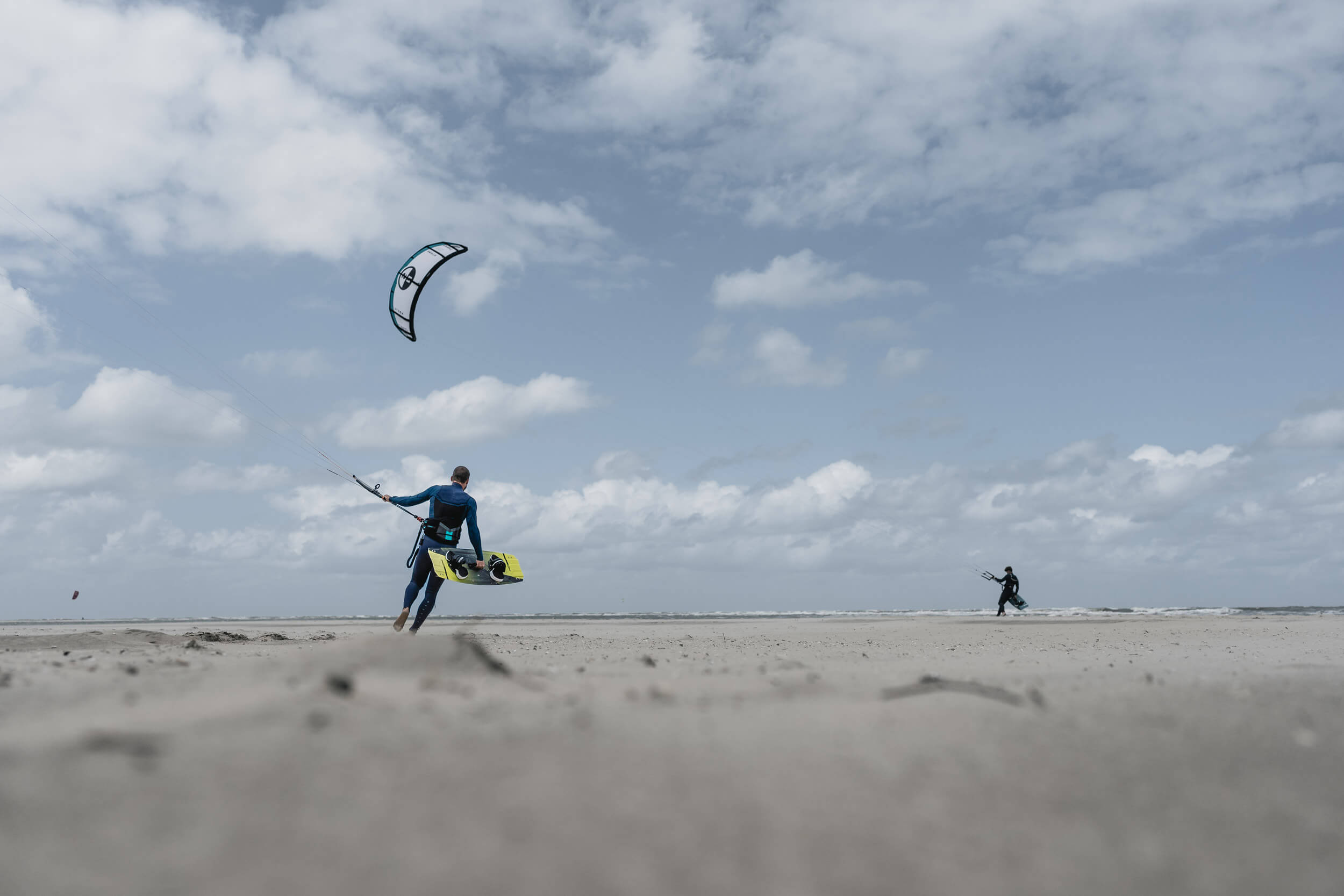
From snowboarding to redefining kite coaching: An interview with Bohdan, head coach and innovator.
You’ve been coaching for almost 12 years. How did it all start? “It actually started with snowboarding. I grew up in a small village where, in winter, we could ski during school lessons. But the moment I saw a snowboard on TV for the first time, something clicked. I didn’t even get the chance to try it until I was 21, when I was studying at university. Once I stepped on a board, I knew: this is it. I want to do this every single day.”
That sounds like a turning point. “Definitely. At first it was just fun, but snowboarding is expensive, so I started working as an instructor. After one season I began taking courses, entering competitions, and winning some of them. That’s when I realised this wasn’t just a passion anymore, it had become my life.”
When did you realise you weren’t just an athlete, but also a teacher? “I think around 23. What really drives me is understanding the root of a problem. Many instructors fix symptoms, but I want to understand why something is happening. In coaching, that means seeing where a mistake actually starts and building a clear path to fix it.”
That sounds like a specific talent? “People tell me that, but I don’t like to talk about myself too much. I prefer feedback from students. I believe in showing results rather than selling myself with words.”
Who has taught you the most valuable lessons? “ That would be Semen Skubenych. A wise man beyond his years, coach of the Ukrainian national snowboarding team and a good friend of mine. He helped me to change my mindset and the way of thinking about ‘how to teach people’, which helped me change myself and made me who I am now.”
From Snow to Water
After snowboarding, how did kiteboarding enter your life? “Through a student. He asked what I was going to do in summer and invited me to try kitesurfing. I had no idea what it was. After one lesson, two hours in, I was riding both directions. The instructor told me I was the fastest learner he’d seen in 15 years. That definitely came from my snowboarding background; board feel, physics, body position.”
And then it escalated quickly. “Yes. The next day I was already doing jumps. Later that season I went to Tarifa, Spain, to teach, where I learned a hard lesson: I wasn’t ready yet. A friend had introduced me to a kite school owner. But after watching me ride, she was very direct with me. She said, “I want to be honest with you. You’re definitely not a kitesurfer yet. And you’re definitely not ready to be an instructor. Your skills aren’t strong enough for you to even feel confident on your own.”
I was used to different waters and definitely places less crowded than Tarifa!
But they saw the potential. So instead of giving up, I studied. I watched lessons, observed teaching styles, analysed everything. Within days I was teaching beginners under supervision, and shortly after, independently.
The reason I’m so passionate about this sport is the freedom it gives me. The feeling that my body is really flying through the air. Even when I was snowboarding, I was always focused on jumps and tricks, because that was the moment when I felt truly weightless.
But kitesurfing hooked me in a completely different way. There’s no other sport in the world where, in just two or three seconds, you can jump more than twenty meters high, fly hundreds of meters downwind, and land softly and safely, almost like a butterfly touching a leaf.”
Why he built his own teaching method
At some point you stopped trusting existing systems. Why? “It happened during a class I was teaching. One student asked me how to do a water start. I realised there were ten different ‘official’ answers, depending on who you asked. That moment made me decide: I can’t rely blindly on any system. I started breaking everything down myself; testing, feeling, analyzing and slowly building my own method.”
That led to conflict, didn’t it? “Yes. I proposed changes at a big school in Ukraine. They listened, but didn’t believe in it. Eventually I was told to either follow the standard system or leave. That’s when I decided to open my own school. Scary, yes, especially the business side, but also necessary if I wanted to stay true to myself. And it worked.”
The Netherlands & A new chapter
Right now, you’re teaching at Kiteschool Zeeland. How did you end up in the Netherlands?
“After the war started in Ukraine, everything changed. We chose the Netherlands because of wind conditions and climate. That’s where I met Arjen and started working here.”
And again, your teaching stood out.
“Honestly, at first it caused confusion, different instructors teaching differently. But after long conversations and testing my method in practice, the results spoke for themselves. Within ten minutes, other instructors could feel and see the difference too. The whole school shifted its approach.”
On equipment, innovation & trust
You’re very outspoken about gear. Why?
“I’m always honest. If something doesn’t work for my students, I’ll say it, no matter how popular the brand is. Progress only happens when honesty is present.”
That honesty also shows in your relationship with boards. How did your collaboration with Roode Boards begin? “Arjen connected us. Marijn had just started developing boards and wanted feedback. I tested an early Silica prototype in the Netherlands, which is a very choppy spot. At first, I wasn’t blown away, but I felt potential.
I asked to take it to Egypt, where conditions are flat. That’s where it clicked. One of the best sessions of my life; golden hour, perfect wind. The takeoff impressed me most. It held the edge well, built speed easily, and boosted beautifully.
The second-generation Silica was even better. At that point, I was almost fully convinced. Silica is extremely versatile; it works for many riding styles and skill levels. But for my style of riding I was missing that last 1%..”
And then came the Graphite. “Yes. Me, being myself and honest, told Marijn that the Silica was great, but for extreme big air, I felt like I needed something more. Something just a little different. His reaction? ‘I’ve got you!’ He was already working on a new model, the Graphite! What a big surprise. The first session on the Graphite was unreal. From the first moment, I felt something different. The first jump completely blew my mind. I thought, okay, calm down, this might just be first-session excitement. But it wasn’t.
I rode for hours. I jumped higher than ever before. I did tricks I had never done in my life. The board unlocked something new in my riding. Before that, my personal height record was 22 meters. On my first serious session with the Graphite (in 45–47 knots) I jumped 26 meters. Four meters higher instantly.
It is insane! The board performs 30–40% better than anything I’ve ridden before. The explosive takeoff, the grip, the control under extreme pressure; it’s on another level. It’s playful when you want it, aggressive when you need it.
After that session, I told everyone on the beach: this is the best board I’ve ever ridden.
So gear really matters. “Absolutely. Technique can only take you so far. At some point, equipment must evolve with the rider. Otherwise, it holds you back.”
Freedom, fearlessness & The next generation
What’s a perfect kite day for you? (laughs) “I wanted to say ‘blue skies and flat water. but that would be lying. I love Strong wind. Dark skies. Conditions that challenge me mentally. That’s where growth happens.”
And when there’s no wind? “I fly. Paragliding, coastal soaring, often with my daughter. Flying has always been the core of everything I love. Snowboarding, kiting, soaring; it’s all about that same feeling.”
Looking back, any regrets? “Only that I didn’t start sports earlier as a child. But at the same time, everything that happened made me who I am now.”